
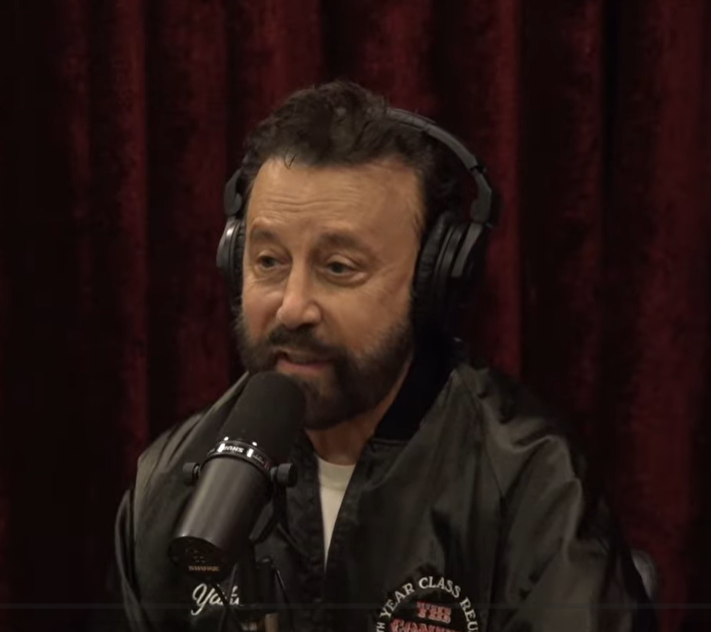
The Soviet government was starving its own people when Jimmy Carter offered them a deal: American grain in exchange for letting citizens emigrate. Yakov Smirnoff, a comedian who became a breakout standup star in the 1980s, was one of the people who took the deal.
"He wanted to see some human rights in the Soviet Union... that's how we got out," Smirnoff told Joe Rogan on his podcast this week.
Smirnoff's appearance on the September 24 episode wasn't a nostalgia tour. It was a firsthand account of what life looks like when the government decides it knows better than its citizens — what they eat, where they work, how much they are allowed to make each month, what they say, where they go, whether they leave. The comedian who built a career on the contrast between Soviet misery and American abundance sat across from Rogan and described the machinery of total state control with the calm of a man who lived inside it.
The Carter administration's grain-for-emigration arrangement is one of those details that rarely makes it into the classroom version of Cold War history. The Soviet leadership couldn't feed its population. The United States could. Carter leveraged that into a human rights concession — actual people getting out of an actual communist country — in exchange for shipping American agricultural surplus to Moscow. It wasn't a treaty. It wasn't a summit photo op. It was grain for bodies, and Smirnoff's family was among the bodies.
Rogan, to his credit, didn't treat the conversation like an interview. He treated it like a warning.
"What people do when they have power is they enact total control over the population," Rogan said. The line landed flat, not because it was wrong, but because it described something Smirnoff didn't have to imagine. He'd already seen it. He'd lived under a system where the state controlled the food supply so completely that a foreign grain shipment became the only leverage available to pry open the exit.
"Wow. Holy s---, man... you sometimes need to be reminded how fortunate you are," Rogan said at the 10:06 mark of the episode.
That sentence is doing more work than it sounds like. Rogan has the largest podcast audience in the country. His listeners skew young, male, politically skeptical — exactly the demographic that's been marinated in "capitalism is the problem" messaging since middle school. Hearing a man who escaped communism describe what the alternative actually looks like, in plain language, without academic framing or partisan packaging, is the kind of thing that lands differently than a textbook.
Smirnoff didn't use the word "socialism." He didn't have to. He described a country where the government controlled the food, controlled the borders, controlled who could leave and under what conditions. He described a country where an American president had to trade agricultural commodities just to get a few families out. The vocabulary doesn't matter when the picture is that clear.
The timing is worth noting. We're watching a generation of American politicians campaign on expanding government control over healthcare, energy, housing, and education — and framing every objection as corporate greed or right-wing obstruction. The word "socialism" polls well with voters under 35. Democratic Socialists of America chapters operate on college campuses without a trace of irony. The ideology that starved Smirnoff's country into accepting grain shipments from Kansas is being repackaged as compassion.
Smirnoff built a comedy career on a single joke structure: "In America, you do X. In Soviet Russia, X does you." It was funny because the contrast was absurd. America was free and abundant. The Soviet Union was a surveillance state that couldn't keep the lights on. The bit worked because nobody in the audience had any confusion about which system was better.
That clarity is what's eroding. Not because the facts changed, but because the people who lived through the comparison are aging out of the conversation. Smirnoff is in his seventies. The Soviet Union dissolved thirty-five years ago. For a twenty-year-old American, communism isn't a memory — it's a Wikipedia entry, easily reframed by a professor with tenure and a theory.
Rogan gave Smirnoff ninety minutes to make the case that no syllabus will. A man who stood in bread lines, whose family's freedom was purchased with American wheat, sitting in a studio in Austin, Texas, explaining what the governmenteli looks like from the inside.
The Soviet Union didn't collapse because of a policy debate. It collapsed because it couldn't feed itself.