
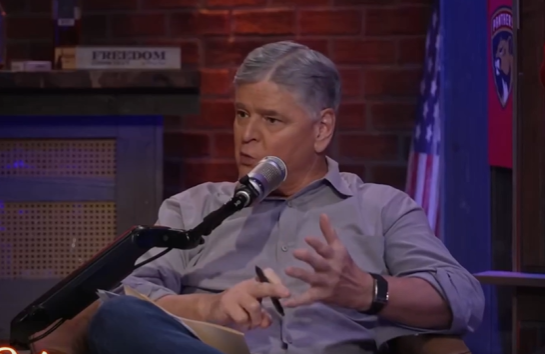
"I was being pressured to tell my audience to take the jab."
That's Sean Hannity speaking on a podcast with Dr. Drew Pinsky five years after the COVID vaccine rollout turned every newsroom in America into a pharmaceutical sales floor. Hannity is now confirming what millions of viewers suspected at the time: somebody was leaning on him to sell it.
Hannity confirmed the pressure existed. He did not say whether it came from Fox News management, from government officials, from pharmaceutical sponsors, or from some combination of the three. The pressure was real. The source stays protected.
What Hannity did say is that he refused to comply — at least in the way the pressure demanded. "I'm not a doctor. I'm just not. I don't know anything about your health," he told Dr. Drew Pinsky. "I don't know anything about your preexisting conditions, your current condition, comorbidities you may have, and I don't know anything about this shot."
So instead of reading the script, Hannity says he did something unusual for cable news in 2021: he put people with different views on air. "But I kept putting people with different views on, and I said, 'Take it seriously, consult your doctor, make your own mind up,'" he explained.
Anyone who watched Hannity during that period remembers the tightrope. His on-air position in 2021 was carefully worded: "Research like crazy, talk to your doctor, your doctors, medical professionals you trust based on your unique medical history." He also said that "vaccination absolutely makes sense for many Americans" and that viewers had "a right to medical privacy" and "doctor-patient confidentiality."
At the time, that stance got him attacked from both directions. The left called him an anti-vaxxer for not demanding universal compliance. Some on the right thought the "talk to your doctor" framing was a soft endorsement. Hannity was threading a needle that the pressure campaign was designed to make impossible — the entire point was that nobody on a major platform should present the vaccine as a personal medical decision. It was supposed to be a civic duty, full stop.
In 2024, Meta CEO Mark Zuckerberg publicly disclosed that Biden administration officials had pressured Meta to remove anti-COVID vaccine related content from its platforms — including humor and satire about the pandemic. The administration wasn't just managing public health messaging. It was managing what Americans were allowed to laugh about.
That's the infrastructure Hannity is describing from the media side. A coordinated effort, spanning government agencies and private platforms, to ensure a single narrative reached the public without interference. When a Fox News host with the largest cable audience in the country says he was "pressured" to deliver a specific medical recommendation to viewers he'd never met, he's describing one node in a system that Zuckerberg already confirmed from another angle.
The question Hannity left unanswered is the one that matters most: who, specifically, applied the pressure? Government officials calling the network? Fox executives passing along advertiser concerns? Direct outreach from public health agencies? Each answer carries different implications. A government official pressuring a journalist to deliver a medical directive to the public is a different category of problem than a network boss worried about ad revenue.
Hannity's refusal to name the source does two things simultaneously. It protects whoever applied the pressure. And it keeps the story focused on a principle — that a television host was asked to practice medicine on camera for an audience of millions — rather than on a personnel dispute that would dominate one news cycle and disappear.
The 2021 vaccine pressure campaign touched every institution that communicates with the American public: social media platforms confirmed it, newsrooms enforced it, government agencies orchestrated it, and employers weaponized it. Hannity's disclosure adds cable news to the list of industries where individuals were personally pressured to deliver the message — not because they believed it, but because someone with leverage asked them to.
He said no. He says he said no. Five years later, that's the part he wanted on the record.
The name of whoever made the ask is still off it.