
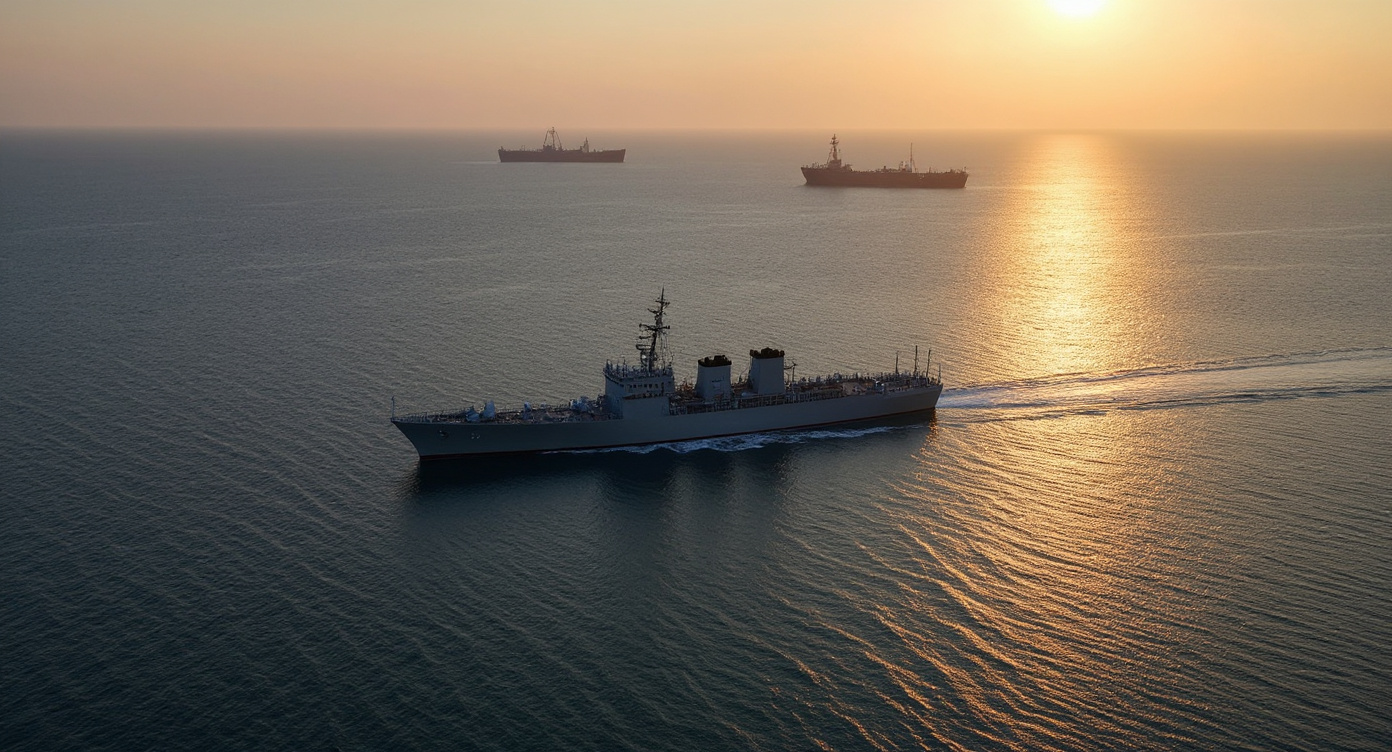
Eight Iranian tankers sit at the bottom of the Persian Gulf. A hundred and twenty-two commercial vessels have been redirected by the U.S. Navy since the blockade began. And as of last week, Iran's leverage over global oil shipping has collapsed so thoroughly that Tehran is now asking — not demanding, asking — for a ceasefire.
President Trump said no.
"I'm rejecting the deal," Trump told reporters at the United Nations. "They want to make a deal where they open the strait immediately because they're losing so badly."
Iran tried to weaponize the Strait of Hormuz — the 21-mile chokepoint through which roughly 17 million barrels of crude per day once flowed — and the Trump administration called the bluff with warships, sanctions, and a willingness to sink Iranian vessels that tested the perimeter. AMAC Newsline's Jason Hayes, a Senior Research Fellow for Energy and Environment at The Heritage Foundation, laid out the full timeline this week, and the numbers tell the story better than any diplomatic cable could.
When Iran first disrupted shipping through the Strait, 17 million barrels per day were held up. After the June Memorandum of Understanding between the U.S. and Gulf allies rerouted tanker traffic through alternative corridors and the Saudi pipeline terminus at Yanbu, flow recovered to 13.5 million barrels per day at its peak. It has since settled at 7.6 million barrels per day through the Strait itself — but Goldman Sachs estimates that total volume, including what it calls "dark crossings" running under naval escort, is closer to 15 to 16 million barrels per day.
Meaning Iran's grand strategy of choking the world's energy supply has resulted in... the world's energy supply finding a way around Iran.
The cost hasn't been zero. Eight U.S. Marines were injured in an Iranian missile attack earlier this year. Gas prices sit at $4.48 per gallon nationally, which nobody loves — but Hayes points out that the inflation-adjusted equivalent during the 2011-2013 period was $5.28 per gallon, and nobody was blockading anything back then. We were just bad at energy policy.
We're not bad at it now. U.S. crude exports hit a record 13.1 million barrels in May, turning what was supposed to be an energy crisis into an American export bonanza. The Atlanta Fed is projecting 5% real GDP growth for Q3. European refiners who used to depend on Gulf crude routed through the Strait are now buying from the U.S. Gulf Coast, Brazil, and Africa.
Iran's position was that threatening global commerce would force the world to negotiate on Tehran's terms. The assumption was that Washington would blink because gas prices would spike and voters would revolt. That calculation depended on an American president who governed by poll numbers.
They got one who governs by leverage.
The Senate Armed Services Committee has been briefed on the naval posture. CENTCOM continues to redirect commercial traffic. The International Energy Agency's latest assessment confirms that global supply chains have adapted faster than anyone predicted — not because the crisis was small, but because the American response was immediate and didn't come with six months of hand-wringing at the UN first.
There's an argument that the blockade is too aggressive, that sinking Iranian tankers risks escalation with Russia and China. It's the same argument that said sanctions on Iranian oil would crash the global economy. The global economy grew. It's the same argument that said rerouting tanker traffic was logistically impossible. A hundred and twenty-two vessels have been rerouted as of September 25.
Iran opened this confrontation holding what they believed was an unbeatable card — control of the world's most important shipping lane. They played it. The U.S. Navy escorted commercial vessels around them, American producers flooded the market with domestic crude, and eight Iranian tankers that tried to enforce the blockade are now artificial reefs.
Tehran came to the UN last week offering to reopen the Strait immediately. Trump's answer was one sentence. The Strait isn't Iran's to reopen anymore.