
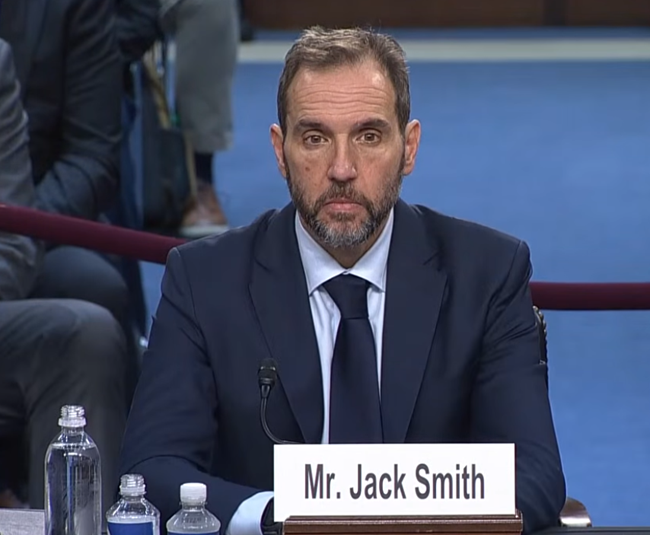
Jack Smith subpoenaed a sitting United States senator's phone records from Verizon, secured a gag order from a federal judge so the senator would never find out, and threatened the telecom company with obstruction of justice charges if anyone breathed a word of it.
The senator was Bill Hagerty of Tennessee. He found out anyway. And on September 30, he filed a formal bar complaint requesting that Jack Smith never practice law again.
The complaint, addressed to R. Culver Schmid — Chairman of the Board of Professional Responsibility of the Supreme Court of Tennessee — accuses Smith of violating the Rules of Professional Conduct during his tenure as Special Counsel under the Biden Department of Justice. According to Hagerty's letter, Smith obtained a nondisclosure order from Chief Judge James Boasberg of the District of D.C. without mentioning a fairly important detail to the judge: the subpoena targeted a sitting United States senator whose phone records almost certainly contained communications about legislative acts. The kind of communications the Constitution specifically protects from exactly this sort of thing.
"The fact that the subpoena to Verizon sought the phone records of members of Congress likely to involve communications concerning legislative acts was undoubtedly material, yet Smith did not disclose it," Hagerty wrote in his letter to Schmid.
That's not a procedural oversight. That's a prosecutor deliberately concealing the nature of his target from a federal judge because he knew what would happen if the judge understood who was on the other end of that subpoena.
Hagerty announced the complaint on X with a summary that left zero room for creative interpretation: "I filed a bar complaint against Jack Smith this morning. He's a blatantly partisan actor and his prosecutorial misconduct damaged our constitutional order. He should never be able to practice law again."
The complaint lays out a specific sequence. Smith subpoenaed Hagerty's records from Verizon. He obtained the nondisclosure order from Chief Judge Boasberg preventing Verizon from notifying the senator. Then he threatened Verizon with obstruction of justice charges to guarantee their silence. A telecom company with a federal prosecutor promising criminal charges if they pick up the phone and call the customer whose records are being seized — that's not a request, it's a shakedown with a government seal on it.
"The invasion of Congress's legislative privileges was complete when Verizon refused to contest the subpoena and handed over my records," Hagerty wrote. His complaint further states that "Smith violated the Rules of Professional Conduct by seeking and obtaining a nondisclosure order from a federal district court without advising the court of critical facts and law."
Nondisclosure orders exist for a reason. When the FBI is tracking a drug cartel's burner phones, nobody expects them to send the target a courtesy text. But when the records belong to a sitting member of the United States Senate and the communications almost certainly involve constitutionally protected legislative activity, the judge signing that order has a right to know exactly whose records he's authorizing. Smith made sure he didn't. The nondisclosure order wasn't protecting an investigation — it was protecting the prosecutor from the constitutional questions that would have stopped the investigation cold.
Hagerty isn't the only senator who thinks Smith's conduct crossed from aggressive into illegal. Sen. Marsha Blackburn has gone further, suggesting Smith should face not just professional discipline but criminal prosecution for his behavior as Special Counsel. We've now got multiple sitting senators pursuing formal legal action against the man who spent years trying to put a former president behind bars, as Breitbart reported.
Smith built his entire career on one premise: nobody is above the law. He repeated it in press conferences, court filings, and through every carefully timed leak to friendly outlets. He wielded grand jury subpoenas and nondisclosure orders and obstruction threats like a man who believed the rules applied to everyone in the room except the person holding the badge.
The Board of Professional Responsibility of the Supreme Court of Tennessee now has a formal complaint on its desk asking whether that includes former special counsels who hide material facts from federal judges. Smith's law license is on the line — and this time, he's the one who won't see the subpoena coming.