
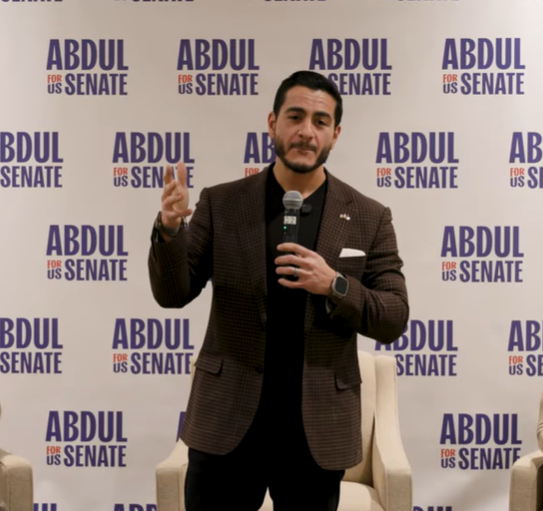
A young man named Tommy stood up at a town hall and asked Michigan Democratic Senate candidate Abdul El-Sayed a straightforward question: Would he disavow the Muslim Brotherhood? El-Sayed didn't answer the question. He demanded Tommy's name first, delivered a lecture about dual loyalties and the Constitution, and then — after the kid left — posted the entire exchange on X with the caption: "This is Tommy. Tommy had a question about my allegiances. Listen to the end to hear about his."
A sitting political candidate used his platform to single out a young voter by name on social media for asking an inconvenient question. That's not confidence. That's a threat.
The timing could not be worse for El-Sayed. Days earlier, J.D. Haltigan, PhD, surfaced a research paper El-Sayed co-authored titled "Interethnic mating and risk for preterm birth among Arab-American mothers: Evidence from the Arab-American Birth Outcomes Study." The paper, which dates to around 2011, found that Arab-American mothers in Michigan who had children with non-Arab fathers had approximately 18 percent higher preterm birth risk compared to those with Arab fathers — a pattern that showed up specifically in later preterm births around 34 to 36 weeks.
The authors noted similar patterns in black-white couples and some Asian-American groups, and suggested genetic differences between interracial parents could contribute to outcomes. The paper acknowledged social and environmental factors like stress and discrimination, but the framing was hard to miss: the research question itself was whether Arab women who "mate" outside their ethnicity have worse outcomes.
Sen. Ted Cruz responded on X: "This is 'science' with a pre-ordained racist & eugenics outcome. Scary stuff."
Steve Guest put El-Sayed's town hall behavior in sharper focus: "Abdul El-Sayed's contempt for his potential constituents is out of control."
He's not wrong. The normal move for a Senate candidate facing an uncomfortable question is to pivot, give a non-answer, maybe crack a joke. El-Sayed chose to publicly identify a young voter by first name, film his exit, and post it as a warning to anyone else thinking about asking questions. That's not a guy running for office. That's a guy running a protection racket on his own town halls.
The Muslim Brotherhood question isn't new for El-Sayed. He's been asked before and has consistently refused to offer a clear disavowal. The standard deflection involves invoking JFK's 1960 speech about Catholic loyalty and framing the question as religious bigotry — which works right up until someone pulls your academic record and finds a paper built around the premise that your ethnic group shouldn't reproduce with outsiders.
That's the part El-Sayed can't lecture his way out of. You don't get to spend your academic career studying the risks of "interethnic mating" among Arab-American women and then call other people bigots for asking about your affiliations. The research speaks a language El-Sayed clearly understands — he just assumed nobody else would ever read it.
Tommy asked one question. El-Sayed answered it — just not the way he intended.