
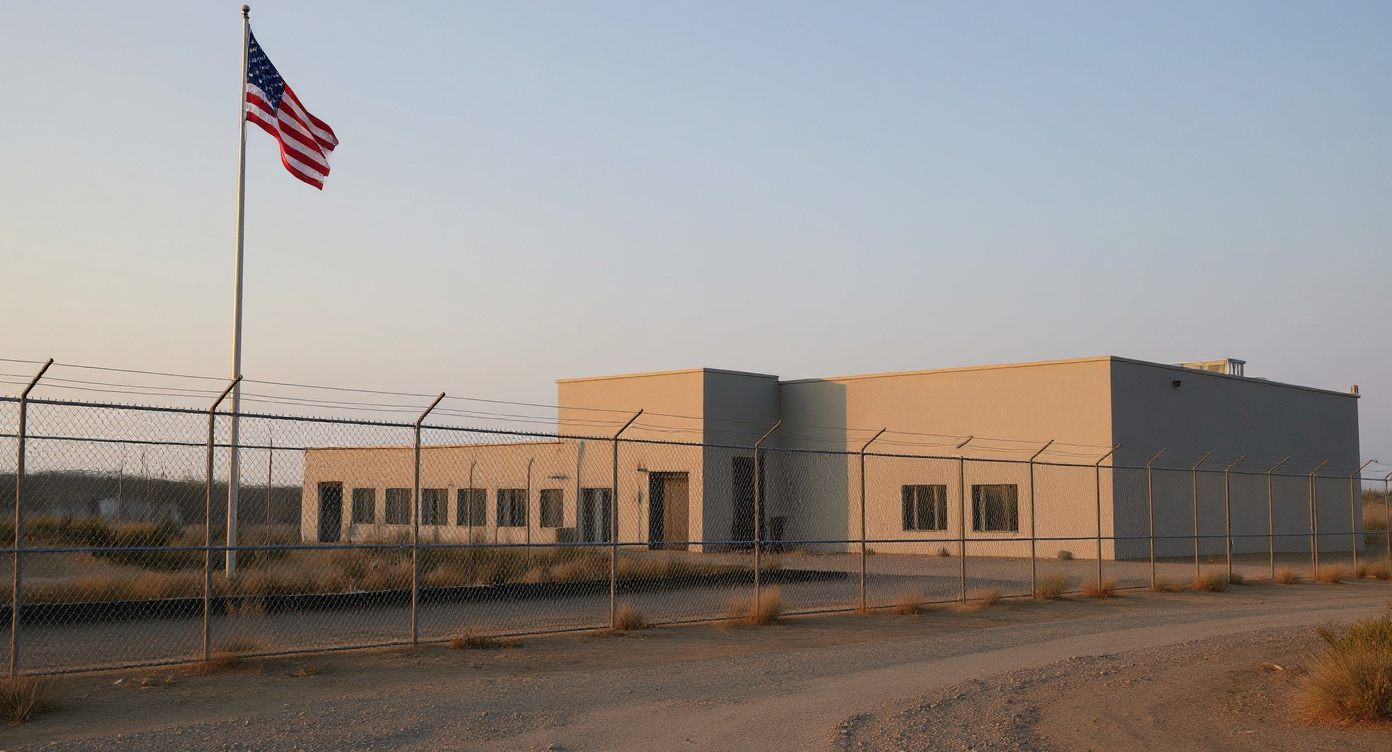
The Department of Homeland Security just spent $1.5 billion to purchase two immigration detention centers in California. Not Texas. Not Florida. California — the state that has spent the better part of a decade trying to make ICE enforcement physically impossible within its borders.
The two facilities — the California City Detention Facility and the Otay Mesa Detention Center in San Diego County — hold a combined 4,500-plus beds and were previously operated by Tennessee-based CoreCivic under contract. Now the federal government owns the buildings outright, and CoreCivic continues managing them under existing agreements that run through August 2027 and December 2029, respectively. DHS can terminate those management contracts at any time for convenience or non-appropriation.
A DHS spokesperson told American Wire News the purchase "was made possible by President Trump's One Big Beautiful Bill that allowed ICE to expand detention space to fulfill the president's promise of mass deportations." The spokesperson also explained the strategic reality behind buying instead of partnering locally: "Unlike in states like Florida and Oklahoma, ICE cannot rely on local state and county partners for detention space in California. The state's sanctuary politicians continue to push legislation to outlaw or make private prisons financially infeasible."
So California spent years passing laws designed to kneecap federal immigration enforcement. And the federal government responded by buying real estate.
"Now, with federal ownership of these detention centers, which are crucial to ICE's detention network on the West Coast, ICE retains the detention capacity needed to arrest, detain and remove illegal aliens," the DHS spokesperson added.
Ryan Gustin, CoreCivic's Public Affairs Senior Director, confirmed the sale was routine business: "Both facilities were purpose-built, specifically designed to care for individuals in a secure environment. Asset transactions of this nature are not uncommon for government." He added, "We have previously completed facility sales to government partners, and operating government-owned facilities is a well-established model within our business."
Democratic Representative Mike Levin of California predictably objected — not to the policy, but to the optics around the president's finances. "His administration decides how many billions of dollars flow to CoreCivic. When CoreCivic's stock rises on a government decision, the president personally benefits," Levin said. He added, "A president should never be able to enrich himself through a choice his own government makes."
The president's financial disclosure lists CoreCivic among hundreds of businesses in broad investment accounts, with income from the company listed as "None (or less than $201)." That's the conflict-of-interest argument — less than two hundred bucks sitting inside a diversified portfolio, while ICE needs 4,500 beds on the West Coast.
The bigger picture is strategic. California's sanctuary apparatus was designed to strangle federal enforcement by cutting off local cooperation, defunding private detention, and making every operational step a legal minefield. The state legislature treated immigration detention the way it treats fossil fuels — something to be regulated out of existence. The One Big Beautiful Bill gave DHS the funding to sidestep that entire playbook by simply buying the facilities outright.
California built a wall around its sanctuary policies. The federal government bought the land on the other side.