
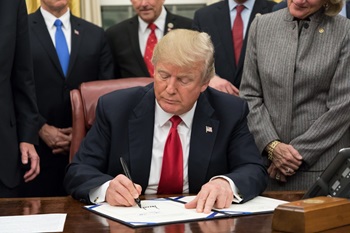
On August 6th, President Trump sat down and signed two executive orders simultaneously — one expanding the categories of foreign nationals whose children don't qualify for automatic birthright citizenship, and another banning birth tourism for the first time in American history. Two signatures, two orders, done.
The Supreme Court told him no the first time. He came back with a different door.
The backstory matters. On June 30th, the Supreme Court ruled against Trump's initial executive order attempting to end birthright citizenship outright under the 14th Amendment. The Court held that citizenship extends to children born in the U.S. "for whom no extraterritorial fiction applies." Trump called it "very unfortunate." Most presidents would've stopped there, issued a statement about respecting the judiciary, and moved on to a safer topic.
Trump's White House deputy chief of staff for policy, Stephen Miller, explained the legal architecture. The first order identifies categories of people whose children are ineligible for automatic birthright citizenship — and it's not a small list. It includes alien enemies of the United States, members of foreign terrorist organizations, and large categories of people who lobby and act on behalf of foreign governments. These aren't new legal concepts. Miller pointed out that these are "historical exceptions to birthright citizenship recognized by the Supreme Court" itself. The administration threaded the needle by working within the framework the Court laid out rather than around it.
The second order takes a different approach entirely. It delegates authority to the Secretary of State and the Secretary of Homeland Security to halt the practice of birth tourism — denying visas to foreign nationals entering the country specifically to give birth. Miller called it the first order "issued for the first time ever in American history to ban birth tourism," describing the practice as "by definition, a fraud on the American system" and "a fraud against the American government."
Trump wasn't subtle about enforcement. "We're cracking down very big, very big, big crackdowns," he said. "This will give us the right to do it in a much more forceful manner." On the industry that's built up around gaming citizenship, he was blunter: "They're building businesses around birthright citizenship. It's a disgrace. They're buying their way in, and we're not going to let it happen."
The legal foundation this time rests on Section 215(a) of the Immigration and Nationality Act — existing statutory authority that doesn't require a constitutional amendment or a new act of Congress. White House staff secretary Will Scharf indicated the orders use "legally validated means" that don't conflict with the Supreme Court's ruling. When asked if the orders would survive legal challenges, Trump's answer was two words: "I think it will."
The usual legal advocacy groups will file the usual challenges in the usual courts. But the structure here is different from the first attempt — narrower in scope, built on recognized exceptions rather than a wholesale reinterpretation of the 14th Amendment, and grounded in immigration statute rather than constitutional overreach.
An entire cottage industry exists around flying pregnant women to the United States, putting them up in hotels, and timing deliveries so the baby is born on American soil with an American birth certificate. That baby becomes a citizen. That citizen becomes an anchor for chain migration. The operation charges a premium and the American taxpayer picks up the downstream tab for decades.
Every president since Reagan has acknowledged the problem. Most gave speeches. Some formed committees. One signed two executive orders on a Wednesday afternoon and told his cabinet secretaries to start enforcing them.
The speeches were free. The orders have a docket number.