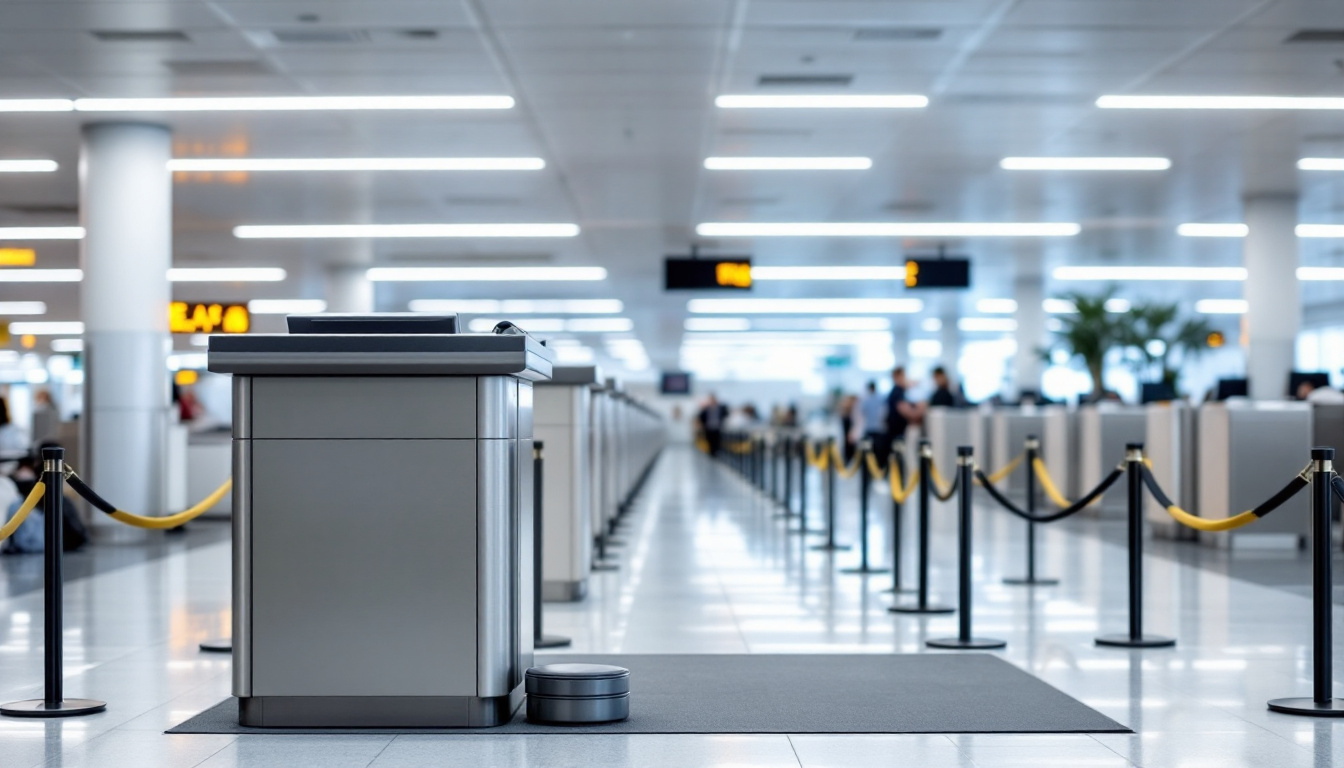
The Transportation Security Administration just removed every chair from every travel document checker podium at every commercial airport in the country. The people checking your boarding pass and ID at the front of the security line are now required to do it standing up.
The union representing those officers called it an attack on "basic safety and common decency."
TSA Administrator David Cummins, confirmed in August 2026, announced the change as part of the agency's Horizon 25 Strategy ahead of TSA's 25th anniversary in November. The agency's statement framed the move in terms no one could reasonably argue with: "This welcome change reinforces both our security posture and our commitment to hospitality by having these officers on their feet and alert."
The statement continued: "All officers must meet fitness for duty requirements to be capable of performing their vital national security function while simultaneously creating a welcoming and professional environment for travelers." Cummins himself put it more directly: "TSA does not have to choose between a secure checkpoint, an efficient checkpoint, and an elevated passenger experience."
So the agency that exists to screen passengers for weapons and explosives decided its officers should be standing, alert, and engaged while doing that job. This is apparently controversial.
The American Federation of Government Employees TSA Council 100, the union representing more than 40,000 TSA officers, fired back immediately. "These chairs serve as basic ergonomic and safety support for officers that stand and walk on hard surfaces all day," the union said. "TSA is treating this matter like it is a privilege — it is not; it is basic safety and common decency for the workforce."
No formal notification was provided to union leadership before the change, which only added to the outrage. The chairs were already gone from most airports before the union even put out its statement.
Here's the thing about that "basic safety" argument. Every retail worker in America stands for an eight-hour shift. Every line cook. Every warehouse worker. Every nurse, every cop on a beat, every soldier standing post. The idea that airport security officers — whose entire job is to visually assess whether the person in front of them matches their ID and poses a threat — should be doing that from a seated position was always a strange concession to comfort over mission.
The union's objection assumes that standing is an extraordinary physical demand rather than the baseline expectation for a security post. Walk into any military installation in the world. Find the gate guard. Count the chairs.
You'll be counting for a while.
Travelers, predictably, are split. Some worry that tired officers means sloppier screening. Others have been watching the person slumped in a chair barely glancing at their ID for years and wondering if anyone at TSA cared about the quality of that interaction. Cummins apparently does.
The Horizon 25 Strategy is broader than chairs. It's a push to professionalize the checkpoint experience across the board — the kind of operational tightening that happens when leadership actually expects performance from a workforce that's spent two decades being the punchline of every airport joke. Whether that translates to measurably better security is a fair question. But the baseline proposition — that the person screening you for threats should be standing up and paying attention — isn't exactly radical.
The union framing this as a worker safety crisis tells you more about the union than the policy. Council 100 didn't argue that seated officers catch more threats. They didn't cite a single data point on screening accuracy. They went straight to ergonomics and decency — the language of grievance, not performance.
More than 40,000 officers. Hundreds of airports. Millions of passengers a day walking past a podium where someone is supposed to be the first line of defense against a threat making it onto an aircraft.
The chairs are gone. The officers are standing. The union filed a complaint.