
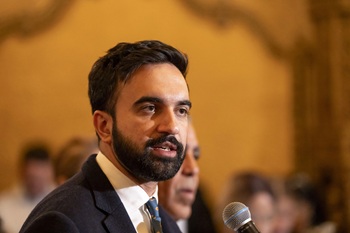
New York City Mayor Zohran Mamdani announced on May 29 that he plans to seize privately owned apartment buildings and hand them over to what he calls "responsible stewards" — including community land trusts. That's not a paraphrase. That's his actual plan, published under his own name, for buildings he decides aren't being managed up to his standards.
Fuel costs for landlords are up 11% in the last year. Insurance is up 10.5%. And Mamdani's Rent Guidelines Board is preparing to freeze rents anyway.
Betsy McCaughey, former Lieutenant Governor of New York and chairman of the Committee to Reduce Infection Deaths, laid it out in a column for Creators.com, published by AMAC. She called Mamdani's rent freeze what it is — expropriation. Her words: "Moscow Mamdani's scheme to deny landlords any rent hikes at all reeks of the kind of expropriation" you'd expect from Cuba or Venezuela, not an American city.
And she's not being hyperbolic. The city already has existing authority to seize buildings under certain conditions. In 2024, fewer than 30 properties were taken. But Mamdani isn't talking about a scalpel. He's talking about a sledgehammer — applied to any landlord who can't keep up with maintenance costs that are rising faster than the rents he'll allow them to charge.
Here's where the math gets ugly. New York currently has an estimated 57,000 "zombie" apartment units sitting vacant. Why? Because a 2019 state law caps the amount a landlord can recover for repairs at $50,000 per unit. If the renovation costs more than that — and in New York City, it almost always does — the landlord can't recoup the investment. So the apartments sit empty, and tenants who need housing get nothing.
Mamdani's answer to this isn't to fix the cap. It's to freeze rents so more landlords go underwater, then seize the buildings when they can't maintain them. This isn't a housing crisis fix, this is how communism starts.
Rent Guidelines Board member Christina Smyth, who was appointed by former Mayor Eric Adams, wasn't subtle about the political nature of the process. She said the rent decision "was decided last year on the campaign trail." Not in a hearing. Not based on cost data. On the campaign trail. She added that if the new administration's goals are ideological, "I will do everything I can to assist them in being successful."
So a sitting board member is publicly admitting the outcome was predetermined. That's not regulation. That's theater with a rubber stamp.
McCaughey pointed to U.S. Supreme Court Justice Clarence Thomas, who in 2023 and again in 2024 flagged rent regulation as raising "an important and pressing question" about constitutional property rights — though the Court declined to hear those cases both times. McCaughey estimates it could take another 2-3 years for a challenge to work its way through the U.S. District Court for the Southern District of New York and back up to the Supreme Court.
That's 2-3 years of frozen rents, rising costs, and a mayor who's already told you what he plans to do with buildings that fall behind. Transfer them to "community land trusts." Government-aligned nonprofits. The buildings don't go back to the market. They go into a system where the city controls who lives there, at what price, forever.
The pattern isn't complicated. Freeze rents below operating costs. Wait for buildings to deteriorate. Blame the landlord. Seize the property. Call it justice.
Property rights used to be the thing that separated us from the countries people were fleeing to get here. In New York, that line is getting harder to find.